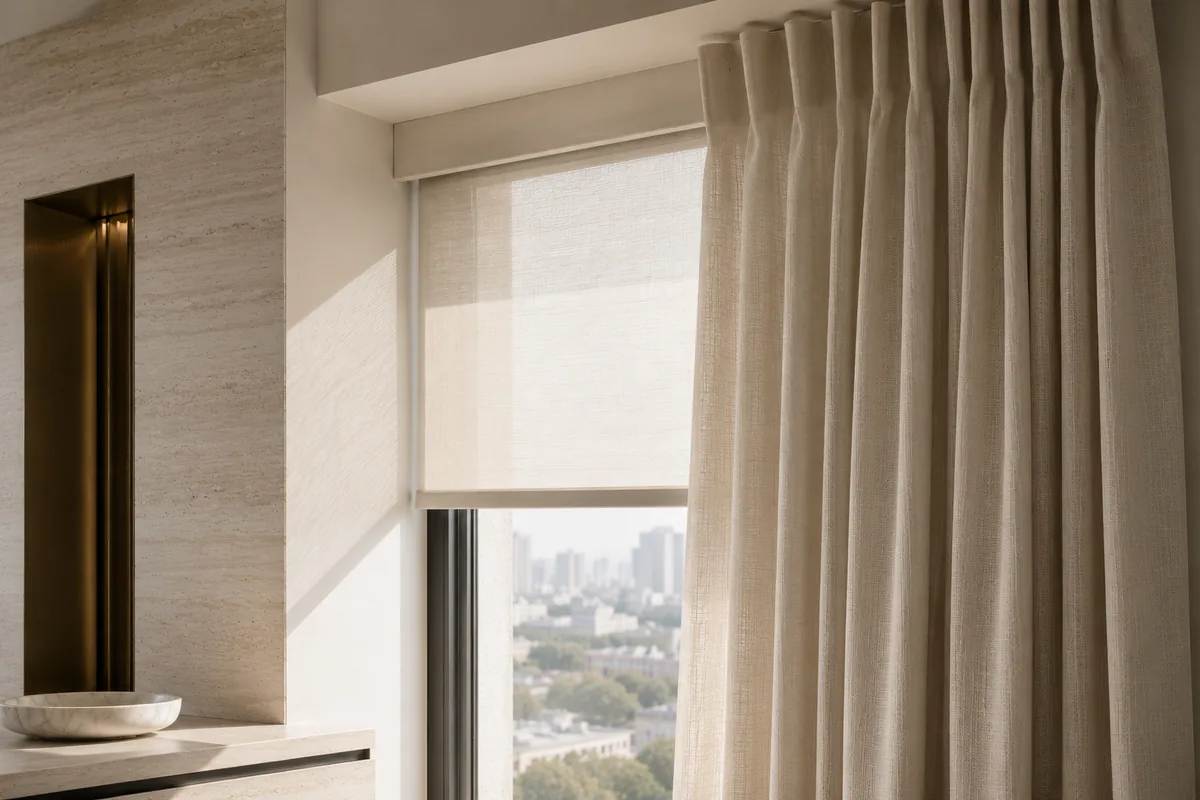
Drapery, shades, upholstery and custom soft goods, specified and made to the
drawing. Textiles are materials — they are simply the ones you touch, and the ones that decide
how much of the day gets into the room.
The Studio
01
Drapery
Made to the window rather than bought to fit it. Weight, lining and heading are specified together, because a drape reads first as a shape and only second as a fabric — and the difference between a hem that hangs and one that flutes is decided before the goods are cut.
Pinch + Euro PleatRipplefoldPanel + StationaryInterlinedHand-Finished HemsTrim + Leading Edge
02
Architectural Shades
Roller and Roman systems drawn into the ceiling rather than mounted onto it. Openness factor is chosen against orientation and glare, not from a chart, and the pocket, fascia and closure are framed at rough-in so nothing about the mechanism is visible in the finished room.
If a room needs a curve, we upholster it rather than shop for it. Frames are built to the plan, in a fabric chosen for how it wears in that seat — a dining chair, a banquette and an occasional chair are three different problems.
Specified for buildings that are used hard: hospitality seating, worship spaces, offices and multifamily amenity rooms. Abrasion, lightfastness and cleaning code are checked against the actual occupancy before anything is presented.
Handwoven, hand-printed and naturally dyed goods sourced through international ateliers and workrooms — often limited, sometimes single-run. Used where a room needs one thing in it that could not have been ordered twice.
The pieces that finish a room and are almost never bought well: bedding built to the mattress, cushions cut to the bench, wall upholstery that doubles as acoustic treatment. All made in the workroom to the drawing.
Motorisation is a construction decision, not an accessory. Power, pockets and control are drawn with the ceiling and the millwork, then commissioned with the rest of the building systems.
Textile Studio owns what the shade is — the fabric, the opacity, the hem, the pocket. How it behaves — scenes, sensors, sun logic and schedules — is designed in Intelligent Environments.
Drapery, upholstery and soft goods are fabricated to the drawing through workrooms we
work with directly. Fit, hem, heading and hand are specified before goods are cut.
Memos + samples
Presented in person.
Textiles are chosen in the room, in its own light, against the stone and the wood
already selected. We bring memos to site rather than mailing a link.
Gray & Grace maintains private trade relationships with mills, workrooms and
ateliers in the U.S. and internationally. Sources and specifications are developed for each commission.